wavy line banner

INCLUSIVITY & INTEGRATION

a group of vegetables in green bags

How much does a Singapore household need for a basic standard of living?

In a study of household budgets by Dr Ng Kok Hoe (Lee Kuan Yew School of Public Policy), A/P Teo Youyenn (Nanyang Technological University), Dr Neo Yu Wei (National University of Singapore), Dr Ad Maulod (Duke-NUS), Dr Stephanie Chok and Wong Yee Lok (LKYSPP), a basic standard of living means “…more than just, housing, food, and clothing. It is about having opportunities to education, employment, and work-life balance, as well as access to healthcare. It enables a sense of belonging, respect, security, and independence. It also includes choices to participate in social activities, and the freedom to engage in one’s cultural and religious practices.”To date, a total of two household budget studies were conducted using the Minimum Income Standards (MIS) as a research method for establishing the incomes needed for a basic standard of living in Singapore. In 2019 the study[1] targeted seniors and in 2021 the study[2] extended this work to the needs of households. The results helped to establish a living wage level, a wage that allows people to afford a decent standard of living and embodies the values and principles that the public identifies with across a range of domains.

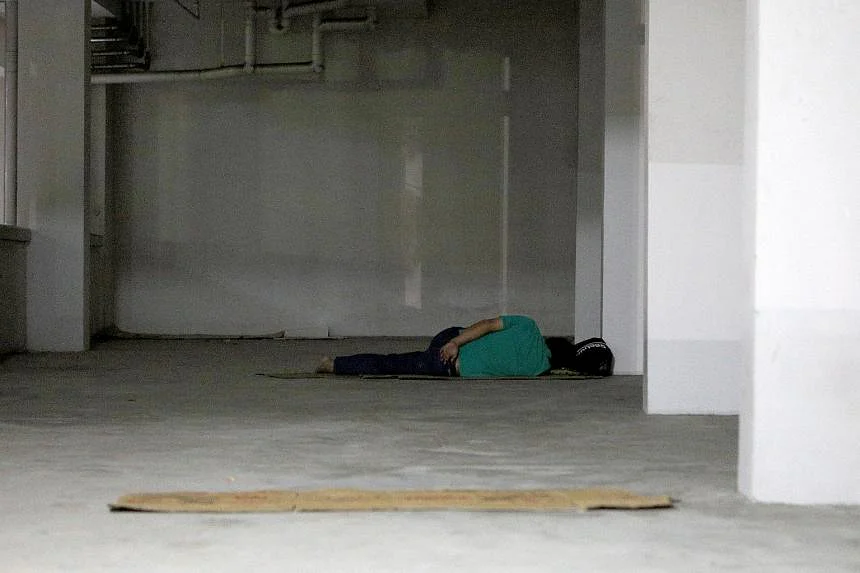
a homeless person sitting on the ground

Homeless during the pandemic: how our Sayang Sayang Fund responded with agility

When Singapore locked down during the pandemic, homelessness became a visible, urgent issue. Cross-border commuters and people that had lost their housing due to irregular income or family conflict joined the rough sleepers who scrape by on the margins of our society.But with any crisis, there is an opportunity to make things better. In this instance, the authorities and social service organisations moved quickly, joining forces to provide temporary shelters. “The rapid expansion of overnight shelter capacity – from around 60 places at the start of 2020 to a peak of 920 during the circuit breaker – was a considerable feat and evidence of what can be achieved with bureaucratic will and an active civil society,” notes a new study called Seeking shelter: Homeless during the COVID-19 pandemic in Singapore.

a group of people sitting at a table with a group of children

4 Critical Educational Gaps for Disadvantaged Children & Youth in Singapore

While abilities and talents are distributed equally across the population, access to educational resources is often not. Children from low-income families are the ones who pay the price. Without the right educational opportunities, they underperform in school and end up with lower-paying jobs. Studies show that students from low-income families are more than four times as likely to be low performers than their affluent peers. (OECD, 2016) Without intervention, this cycle of income inequality will persist.The growing special needs community is also in need of our urgent attention. One key area that we highlight is the need for integration with mainstream students. There needs to be greater awareness about creating better school and work opportunities for this community while preparing them to function independently as adults.

portrait of nadia

#MyGivingJourney x Nadia Ahmad Samdin: Changing the game for giving  

CFS’s #MyGivingJourney series portrays extraordinary women and their efforts in philanthropy. This story features Nadia Ahmad Samdin, CFS’s legacy giving ambassador and a woman who wears many hats. Many who donate to charity often ask: For every dollar they give, what good actually comes of it? Nadia Ahmad Samdin believes increasingly, we will be able to answer that. In a world where tracking usage is commonplace – from our phone use to carbon footprint– a data-driven approach to philanthropy could be a game-changer. The Community Foundation of Singapore (CFS) aligns with Nadia’s belief and strives to be a trustworthy organisation that is transparent and accountable.

portrait of stefanie

#MyGivingJourney x Stefanie Yuen Thio: Maximising impact with her purpose-driven philanthropy 

#MyGivingJourney is a series where CFS features extraordinary women in Singapore and their efforts in philanthropy. This story features Stefanie Yuen Thio, Joint Managing Partner, TSMP Law Corporation and Board of Director at CFS. When COVID-19 first hit in early 2020, Stefanie Yuen Thio was appalled that healthcare workers had trouble getting a taxi or a Grab. It didn’t seem fair: front liners in our fight against the pandemic were shunned because people were afraid, they would transmit the virus. So Stefanie decided to do something about it.

portrait of ravina

#MyGivingJourney X Ravina Kirpalani: Taking family philanthropy to new heights

CFS launched the #MyGivingJourney series, which features extraordinary women in Singapore and their efforts in philanthropy. Our second story features Ravina Kirpalani, Head of Philanthropy at the Enpee Group Foundation, board member of Beyond Social Services and volunteer at HCA Hospice Care. Mention hospice and most people picture the atmosphere to be heavy or depressing. Instead, it is the exact opposite, says Ravina Kirpalani. Ravina has been volunteering at HCA Hospice Care for over 11 years and rates it as one of the most rewarding experiences in her giving journey.

an old lady smiling in front of a tree

Giving mental health a boost – why it matters

When the pandemic hit, seemingly overnight, daily routines and livelihoods were forever changed. Children could no longer play outdoors; youths saw lost time with friends, school, graduations and more; while adults straddle an ever-changing array of challenges – from coping with loss of work to additional care-giving duties.

Scroll to Top